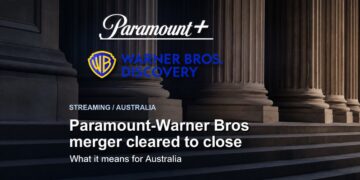





























Paramount-Warner Bros merger cleared to close: what it means for Australia – Paramount’s acquisition of Warner Bros. Discovery is finally moving towards completion after settlements with 12 US state attorneys general and the Writers Guild of America removed the final major legal roadblocks.
Paramount chairman and chief executive David Ellison told employees that the company now has complete clearance for the merger. He said Paramount was tentatively planning to close the transaction in approximately two weeks, although the settlement with the states still requires approval from a federal judge.
For Australian viewers, the deal is significant. The combined company will own Channel 10, Paramount+, HBO Max and a huge catalogue spanning Warner Bros., HBO, CBS, CNN, DC, Discovery, Nickelodeon and Paramount Pictures. It also creates a path towards one combined streaming service, but that change will not happen immediately and local pricing, branding and migration details remain unannounced.
The last legal barriers have been removed
California Attorney General Rob Bonta led the group of 12 states that sued in July to block the merger on competition grounds. The Writers Guild of America launched a separate challenge soon afterwards.
Those cases had forced Paramount and Warner Bros. Discovery to pause the transaction while a full antitrust trial loomed. Paramount had already secured clearances in almost 70 jurisdictions, including Australia, and the US Department of Justice closed its investigation in June.
The new settlements end both challenges. However, Bonta stressed that the agreement was not an endorsement of the merger. Instead, the states secured enforceable commitments covering film production, workers, cable negotiations and the editorial independence of CNN and CBS News.
Ellison described the result as the completion of the clearance process. In his staff memo, he also cautioned that closing would only be the starting line because integrating two companies of this scale would take time.
What Paramount agreed to do
The settlement establishes a five-year production plan for the combined company. Paramount must release 30 films in each of the first two years after the merger and 32 films in each of the following three years.
At least four releases each year must be independent films. Twenty per cent of the annual slate must also be large-budget tentpole films, supporting cinemas and the wider production economy.
Paramount has committed at least US$1.5 billion in additional domestic film production spending over five years. A separate US$25 million fund will support the acquisition of independent films.
The requirements have substantial penalties. If Paramount misses its film-output commitment, it can be forced to sell Miramax and pay US$30 million for every film below the target. Most of that money would support industry health and retirement funds.
A US$47.5 million workforce fund will provide training and career support for people displaced by the merger. Paramount must also honour existing collective agreements and bargain in good faith with unions.
CNN and CBS News will receive independent oversight
The combined company will control two of America’s best-known news organisations: CNN and CBS News. The settlement requires a five-member editorial independence board made up of experienced current or former journalists.
No more than two members may be affiliated with the same political party. The board is intended to monitor independent, objective and fact-based journalism across both newsrooms for three years.
Paramount must also negotiate fees for its own cable channels separately from Warner Bros. Discovery channels for five years. That provision is designed to limit the merged company’s bargaining power with distributors. A breach could require the sale of some cable assets.
The Writers Guild settlement offers narrower protection
The Writers Guild of America said it still believed the merger would damage writers and the industry. However, the guild acknowledged that continuing a complex antitrust case alone, after the states settled, would cost millions of dollars.
Under its separate agreement, Paramount cannot lay off writers at CBS News Broadcast for five years. The company will also contribute US$17.5 million to the WGA health fund and pay the guild’s legal costs.
Those protections do not remove broader employment concerns. Paramount has previously identified more than US$6 billion in potential savings from eliminating duplicated operations. The state settlement’s workforce fund anticipates that some jobs will still be lost as the companies integrate.
How the merger reached this point
Warner Bros. Discovery initially agreed to a transaction with Netflix in December 2025. Paramount then launched a competing all-cash offer and ultimately secured a definitive agreement on 27 February 2026.
Under that deal, Paramount will pay US$31 for each Warner Bros. Discovery share. The acquisition has been described as worth about US$81 billion in equity and approximately US$110 billion on an enterprise-value basis, which includes debt.




Warner Bros. Discovery shareholders approved the transaction in April. The US Department of Justice cleared it in June after reviewing streaming, linear television and theatrical film competition. Regulators in Australia, the United Kingdom, the European Union and dozens of other territories also granted approval.
The state and WGA lawsuits then became the final obstacles. A federal judge paused the merger in July while the cases advanced, before the 21 September settlements opened the way to closing.
What changes for Channel 10 in Australia
Channel 10 already sits within Paramount Australia and New Zealand. Once the deal closes, the free-to-air network will become part of the much larger combined Paramount and Warner Bros. Discovery group.
That gives the owner of Channel 10 access to an expanded portfolio of studios, franchises and production businesses. However, access does not automatically mean every Warner Bros. Discovery title will move to Channel 10 or 10’s digital platforms.
Programme rights are often controlled by existing multi-year contracts, territorial arrangements and separate windows. No new Australian content strategy for Channel 10 has been announced, and there is no confirmed timetable for changes to its schedule or commissioning plans.
Paramount+ and HBO Max will eventually come together
Paramount has said it plans to combine Paramount+ and HBO Max into a single direct-to-consumer platform. That would bring franchises including Star Trek, Yellowstone, South Park, Harry Potter, Game of Thrones and the DC universe under one subscription product.
For Australian customers, the clearest potential benefit is one service rather than two separate subscriptions. The combined library could also create a stronger competitor to Netflix, Prime Video and Disney+.
However, Australians should not cancel or change subscriptions yet. Paramount has not announced when the combined platform will launch here, what it will be called, how much it will cost or how existing Paramount+ and HBO Max accounts will be transferred.
It is also unknown whether every current tier, add-on, bundle and promotional arrangement will survive. The merger may eventually simplify access, but the immediate customer experience remains unchanged until the company publishes a local transition plan.
What happens to Foxtel and Nine deals
Warner Bros. Discovery has existing Australian partnerships beyond its direct HBO Max service. Foxtel became an HBO Max launch partner, allowing eligible customers to access the app through its distribution arrangements.
Nine also has a commercial relationship with Warner Bros. Discovery as the Australian advertising sales partner for HBO Max. Other Warner content and channel arrangements may involve separate licensing windows across broadcasters and subscription platforms.
Nothing in the settlement automatically cancels those contracts. Existing agreements may continue until they expire, are renegotiated or include change-of-control provisions that can be exercised.
The US Department of Justice said its investigation found no evidence that Paramount would stop licensing content broadly after the merger. Even so, the combined company will have more power to decide which programmes remain with third parties and which are kept for its own platforms once current rights become available.
That leaves Foxtel, Nine and other Australian partners in a wait-and-see position. The biggest changes are likely to emerge gradually through contract renewals rather than on the day the merger closes.
Closing the deal is the beginning, not the end
The expected close will settle the ownership question, but it will start a much longer integration process. Paramount must combine corporate teams, streaming technology, advertising operations and distribution relationships while maintaining the settlement commitments.
For viewers, the most visible eventual change should be the union of Paramount+ and HBO Max. For the Australian industry, the more important questions concern Channel 10’s place inside the group, future local production and the fate of content agreements with rival platforms and broadcasters.
Those answers will arrive after closing. Until then, the merger is cleared to proceed, while Australia’s services, subscriptions and existing television deals continue as they are.
For more TV Central Paramount+ news, head here, and explore our HBO Max coverage here. Read Paramount’s official merger announcement.

