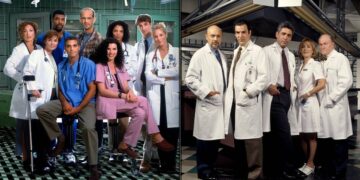

































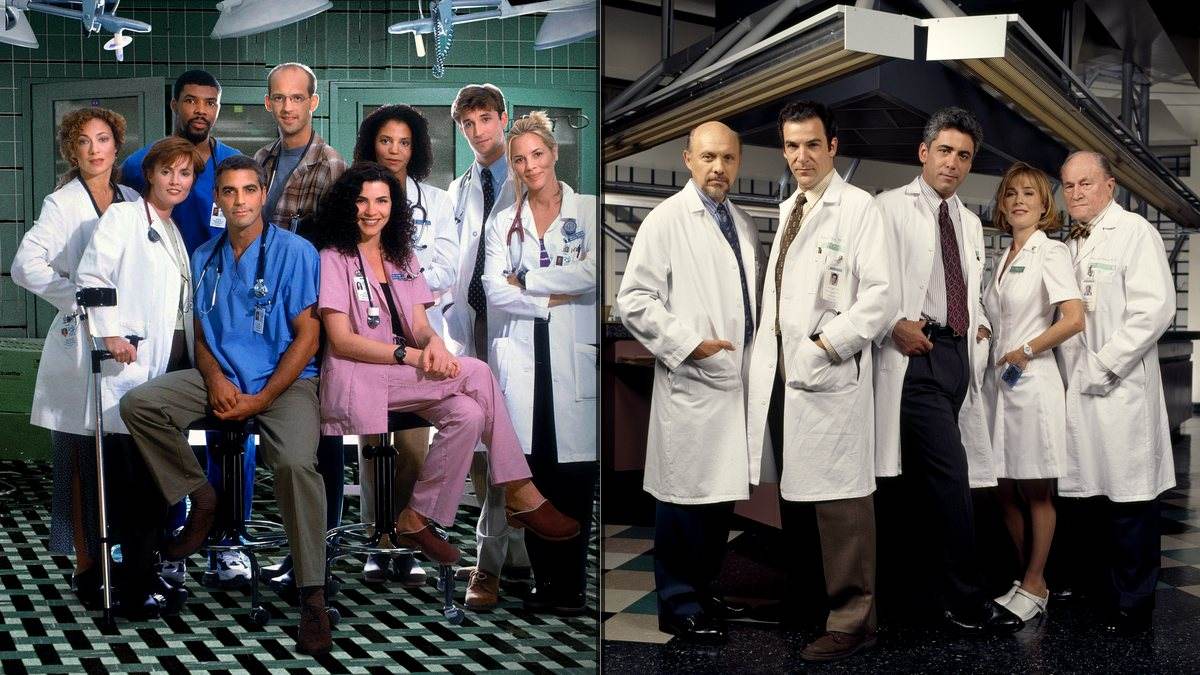

Chicago Hope, ER And The 90s Medical Drama Rivalry Australians Watched Across Two Networks – In Australia, the great 1990s medical-drama rivalry did not belong to one channel.
ER became one of the defining imported dramas of the decade on Channel 9. Chicago Hope, created by David E. Kelley, gave Channel 7 its own prestige hospital drama from the same US television moment.
That Australian split gives the story a different shape from the usual US ratings comparison. American viewers saw two new hospital dramas collide in 1994. Australian viewers experienced them through rival commercial networks, with one becoming a long-running juggernaut and the other becoming a slightly harder-to-find memory of 90s television ambition.
Two hospital dramas, one television moment
Chicago Hope premiered in the United States on CBS in September 1994. ER followed on NBC the next night. Both were ensemble medical dramas. Both had serious creative pedigree. Both arrived when broadcast television still had the power to turn a weekly drama into a national appointment.
However, the two shows had very different instincts. ER, created from Michael Crichton’s material and shaped for television by John Wells and others, had speed. Its emergency-room scenes moved with restless urgency, turning trauma medicine into a form of kinetic prime-time storytelling.
Chicago Hope leaned more heavily into character, ethics and professional conflict. Kelley had already proved with L.A. Law and Picket Fences that he could make institutions feel morally unstable. In a hospital, that skill gave him cases where medicine, ego, grief and principle could collide.
Speaking to the Television Academy, Kelley said CBS asked whether he would be interested in creating a medical show. He remembered St. Elsewhere as one of the series he loved before entering television, then researched the world by meeting doctors and touring operating rooms.
“I’ll give this a try.”
David E. Kelley, speaking to the Television Academy about developing Chicago Hope
Why ER became the bigger cultural force
ER did not merely win a time-slot fight. It changed what many viewers expected a medical drama to feel like. The pace, handheld energy, overlapping dialogue and sense of constant triage made the show feel urgent even before its characters had become household names.
The Television Academy’s oral history of the ER pilot describes the long journey behind the series and the importance of NBC’s Thursday 10pm slot. Once the show landed, it had the rare mix of craft, casting and momentum that can define a network era.
In Australia, Channel 9 benefited from that momentum. George Clooney, Anthony Edwards, Julianna Margulies, Noah Wyle and Eriq La Salle became familiar faces in Australian living rooms, and ER kept refreshing itself through cast changes long after its original breakout years.
Its longevity tells the story. ER ran for 15 seasons, from 1994 to 2009. Chicago Hope ran for six seasons, from 1994 to 2000. That difference does not make Chicago Hope a failure. Six seasons is a serious run, especially against a rival as dominant as ER.
Chicago Hope deserves more than a footnote
The problem for Chicago Hope is not that it vanished quickly. It did not. The problem is that ER became so large that it turned almost every other 90s hospital drama into a comparison point.
Chicago Hope had its own identity. Mandy Patinkin’s Jeffrey Geiger brought volatility and pain to the centre of the show. Adam Arkin, Héctor Elizondo, Christine Lahti, Peter Berg, Rocky Carroll and later cast members helped build a series that often felt more operatic than procedural.
It was also recognisably a David E. Kelley show. The medicine mattered, but so did the argument around the medicine. Chicago Hope was drawn to professional arrogance, ethical uncertainty and the messy emotional lives of gifted people who could save strangers while damaging themselves.
That makes its current absence from Australian streaming feel like a gap. PlayPilot Australia currently lists Chicago Hope as unavailable to stream locally. ER, by contrast, is easy to revisit: JustWatch Australia lists it on Netflix, HBO Max and ABC iview, among other options.
Why the rivalry still matters now
The renewed interest in medical dramas did not come from nowhere. Shows such as The Pitt have reminded viewers that hospital television can still work when it treats pressure, procedure and character with seriousness.
That is why the 1994 collision between ER and Chicago Hope remains useful. ER shows the power of momentum and immersive pace. Chicago Hope shows the appeal of moral debate and actor-driven conflict. Together, they explain why the hospital remains one of television’s most durable dramatic spaces.
For Australian viewers, the memory is also tied to how imported dramas travelled before streaming. You did not simply choose a title from a menu. You found it on Channel 9 or Channel 7, followed the schedule, missed episodes, caught repeats and built loyalty through routine.
ER won the larger cultural argument. Chicago Hope still deserves a hearing. One was the adrenaline rush. The other was the ethical migraine. Australian television was better for having both.
For more free-to-air television coverage, visit TV Central’s Channel 7 and Channel 9 sections. David E. Kelley’s reflections on creating Chicago Hope are available through the Television Academy.