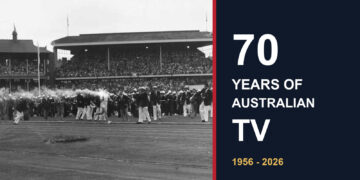

































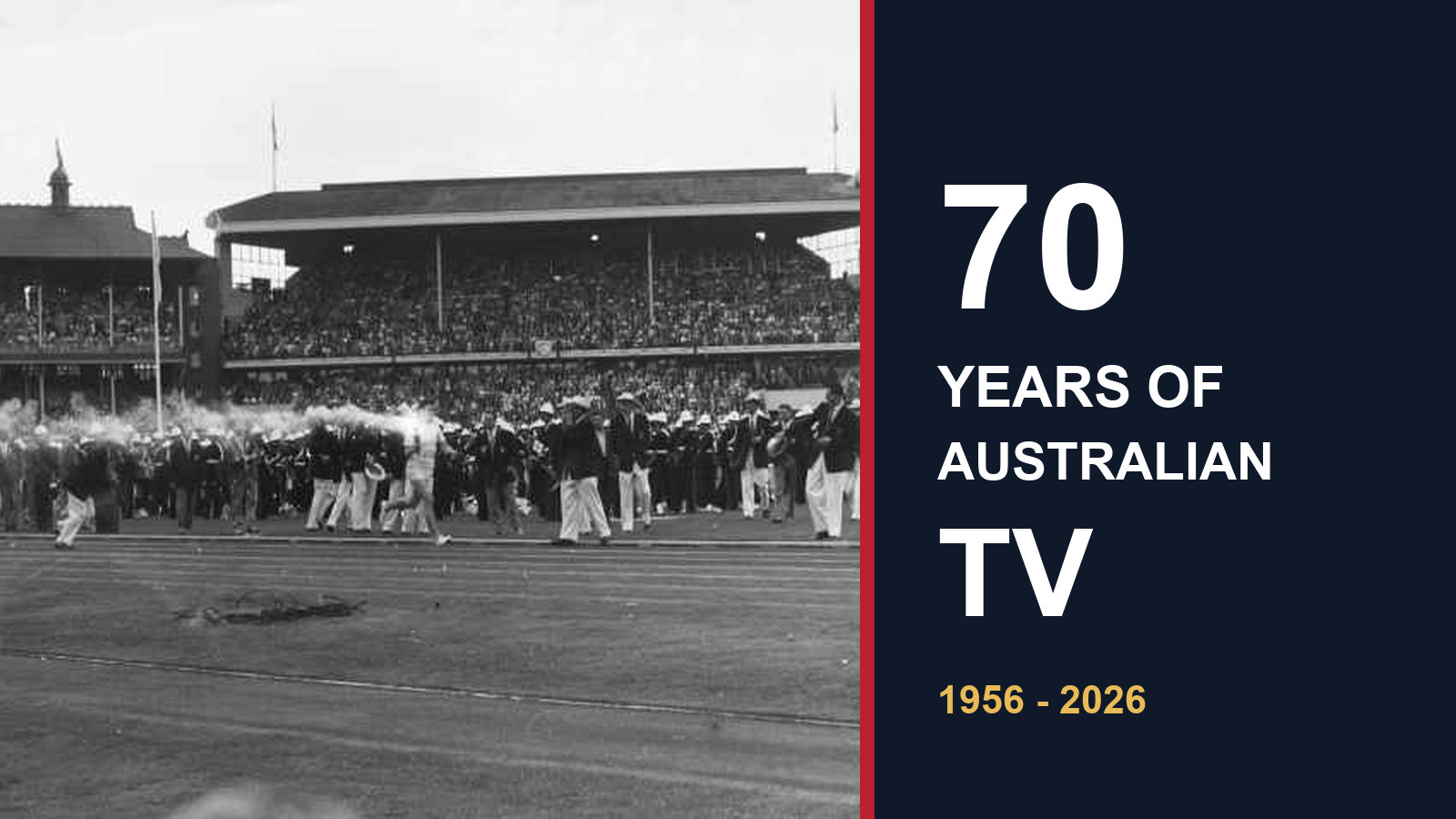


70 years of Australian TV: how the 1956 Melbourne Olympics switched the nation on – Seventy years ago this week, Australia was racing to finish building its television system. The deadline was the 1956 Melbourne Olympics, which opened at the MCG on 22 November 1956, exactly 70 years ago tomorrow.
The Games became television’s first big test in Australia. Within a few weeks, viewers who had never owned a set were crowding around shop windows to watch history unfold.
This month also marks 70 years since Melbourne’s first stations went to air. Seven marked its anniversary with a special, as TV Central reported in October, but the full story stretches across every network.
A slow start for Australian television
Australia was in no hurry to embrace TV. Prime Minister Ben Chifley announced a national television service in 1949, but his successor was far less keen.
I hope this thing will not come to Australia in my term of office.
Robert Menzies, 1952, as recorded by the National Museum of Australia
Nevertheless, a royal commission followed in 1953 and recommended a dual national and commercial system. In 1955, the first four commercial licences went to established radio and newspaper groups, including the Packer and Fairfax interests, the National Museum of Australia says.
Good evening and welcome to television
Sydney’s TCN-9 made the first official broadcast on 16 September 1956. Announcer John Godson introduced the station at 7pm, and then Bruce Gyngell appeared in a dinner suit to say “Good evening and welcome to television.”
Melbourne followed on Sunday 4 November, when HSV-7 went to air from South Melbourne. The station, owned by the Herald and Weekly Times, opened just 18 days before the Games.
Opening night featured speeches from Prime Minister Robert Menzies and Victorian Premier Henry Bolte. It also included a live show from the Tivoli Theatre, which, according to eMelbourne, featured an early Barry Humphries performance as Edna Everage. Newsreader Eric Pearce dedicated the new station.
We dedicate this station to the full service of the community.
Eric Pearce, HSV-7 opening night, 4 November 1956
Next came the ABC. It began transmitting from Sydney on 5 November, and Melbourne’s ABV-2 went live from Ripponlea on 19 November, just three days before the opening ceremony. Melbourne’s GTV-9 did not officially launch until 19 January 1957.
The first Olympics televised live
The Melbourne Games were the first Olympics televised live, although only to a Melbourne audience, the Old Treasury Building notes. Footage was flown interstate and overseas to be shown afterwards.
Accounts differ slightly on which stations carried the coverage. The National Museum lists TCN-9, HSV-7 and the ABC’s ABN-2. Meanwhile, the Old Treasury Building records GTV-9 televising the Games before its official launch, including underwater pictures from the swimming stadium.
Getting the pictures on air was not simple. Organisers insisted broadcasters pay for film rights, while film companies and TV stations argued the Games were news and should be free. In the end, the payment principle won, setting a precedent for future Olympics, and some rights were confirmed only three days beforehand.
Crowds at the shop windows
Very few Australians owned a set. There were fewer than 100,000 televisions in the country in 1956, and only about five per cent of Melbourne households had one.
They were also expensive. A new 17-inch set cost more than 200 pounds, up to 10 times the average weekly wage, and viewers needed a five-pound licence as well.
As a result, television was often a public event. Crowds gathered outside electrical shops, and on Melbourne’s first night nearly 300 people were turned away from a packed Prahran Town Hall, where a dozen sets were lined up on stage.
From two cities to the whole country
Television stayed in Sydney and Melbourne at first. It reached Queensland, South Australia and Western Australia in 1959, Tasmania in 1960 and the ACT in 1962.
By about 1966, roughly 90 per cent of Melbourne households had a set. In just a decade, the box that Menzies had hoped to avoid was in most Melbourne homes.
For more TV Central Channel 7 news, read about the 70 Years of Seven special. You can explore the history further at the National Museum of Australia.